Address
304 North Cardinal
St. Dorchester Center, MA 02124
Work Hours
Monday to Friday: 7AM - 7PM
Weekend: 10AM - 5PM
Pythagorean numerology is one of the oldest and most structured systems of number symbolism in the Western world. But among all its tools, there is one method that feels especially precise, almost like a psychological blueprint: the Pythagorean Psychomatrix, also known as the Pythagoras Square chart.
If you’ve ever wondered why some people seem naturally confident, emotionally stable, or highly disciplined while others struggle with motivation, self-esteem, or focus, the psychomatrix offers an interesting perspective. It suggests that personality traits are not random. They follow a pattern, and that pattern can be reflected through numbers.
In this article, you’ll learn what the psychomatrix is, how it works, how to calculate it, and how to interpret its most important meanings.
The Pythagorean Psychomatrix is a numerology chart created from your date of birth. Unlike a Life Path Number (which gives a broad direction), the psychomatrix breaks your personality down into specific traits and psychological tendencies.
It is often called the Pythagoras Square because it is traditionally displayed as a 3×3 grid containing numbers from 1 to 9.
Each number represents a different aspect of personality such as:
willpower and character
emotional energy
memory and intelligence
discipline and responsibility
physical vitality
spirituality and intuition
creativity and ambition
The psychomatrix is popular because it is detailed. It doesn’t just tell you who you are “in general.” It shows what is strong, what is missing, and what is underdeveloped.
The word “psychomatrix” suggests that this chart reflects a psychological structure. It is not used simply to predict events, but rather to interpret a person’s internal makeup.
Many people describe it as a personality map because it can highlight:
inner emotional needs
behavioral patterns
strengths and weaknesses
hidden potential
psychological imbalances
life challenges connected to personal development
That is why the Pythagorean psychomatrix has become popular not only in spiritual communities, but also among people interested in self-growth, motivation, and relationship patterns.
The Pythagoras Square chart is the grid format used to display your psychomatrix.
It contains 9 fields:
1 | 2 | 3
4 | 5 | 6
7 | 8 | 9
Each number is counted based on how many times it appears in your birthdate (and sometimes additional calculated numbers, depending on the system).
For example, if someone has the number 2 appearing three times, it is written as “222,” and that number becomes a strong energetic signature in the chart.
There are different versions of calculation depending on the numerology tradition, but the most common method includes:
Writing down your birth date (DD.MM.YYYY)
Counting how many times each number 1–9 appears
Placing them into the psychomatrix grid
Adding additional numbers derived from the birth date sum (optional in some systems)
Because calculation methods can vary, many people use online psychomatrix calculators. However, the most important part is not the math itself, but the interpretation.
In the psychomatrix, numbers are not interpreted like “lucky numbers.” Instead, each number symbolizes a psychological function.
Here is a clear breakdown of the most common meanings.
The number 1 represents personal strength, independence, confidence, and the ability to take initiative.
No 1s: difficulty asserting yourself, fear of confrontation
One 1: gentle personality, moderate confidence
Multiple 1s (11, 111): strong willpower, leadership energy
Too many 1s: tendency toward dominance or stubbornness
This number often reveals how easily a person can say “no” and defend personal boundaries.
The number 2 represents life energy, emotional sensitivity, and inner vitality.
People with strong 2s often feel emotions deeply and absorb the atmosphere around them. They may be empathetic and intuitive, but also easily drained.
No 2s: low energetic reserve, fatigue, emotional detachment
One 2: balanced energy
222 or more: high sensitivity, strong emotional charge
Too many 2s: emotional overwhelm, nervous tension
This number often describes how easily someone can recover after stress.
The number 3 represents curiosity, creativity, communication style, and interest in learning.
A strong number 3 suggests someone who is naturally expressive and mentally active.
No 3s: difficulty with motivation, boredom, lack of direction
One 3: normal curiosity
33 or more: strong creative talent, high imagination
Too many 3s: scattered attention, difficulty finishing projects
This number is especially important for people who feel mentally restless.
The number 4 represents physical health, endurance, grounding, and body strength.
It does not mean someone will never get sick, but it reflects the body’s ability to regenerate and maintain balance.
No 4s: low stamina, sensitive body system
One 4: average physical resilience
44 or more: strong constitution, high physical potential
People with strong 4s often benefit from movement, routine, and physical activity.
The number 5 is often interpreted as the balance between logical thinking and intuitive understanding.
It represents mental flexibility and the ability to make decisions based on both reason and instinct.
No 5s: emotional decision-making, confusion
One 5: balanced mind
55 or more: high intelligence, quick thinking
Too many 5s: nervousness, overanalysis
This number is particularly important for people who struggle with anxiety or overthinking.
The number 6 represents duty, responsibility, loyalty, and reliability.
People with strong 6s are often natural caretakers. They take life seriously and feel responsible for others.
No 6s: avoidance of commitment, unstable routines
One 6: balanced responsibility
66 or more: strong sense of duty
Too many 6s: burnout, perfectionism, self-sacrifice
This number can reveal how a person handles obligations and long-term commitments.
The number 7 is often called the “spiritual luck” number. It represents protection, inner faith, and the ability to receive support at the right time.
No 7s: lessons through struggle, life feels heavy
One 7: spiritual potential
Multiple 7s: strong spiritual guidance, intuitive flow
People with strong 7s often experience meaningful coincidences or life-changing turning points.
The number 8 represents power, authority, justice, and the ability to handle material responsibility.
This number is strongly connected to ambition and financial maturity.
No 8s: difficulty with discipline and money structure
One 8: balanced ability to manage responsibilities
88 or more: leadership energy, strong financial potential
Too many 8s: control issues, harsh judgment
In the psychomatrix, the number 8 often shows whether someone is ready to build long-term success.
The number 9 represents memory, learning ability, intelligence, and deep thinking.
People with strong 9s often have a sharp mind and strong observational skills.
No 9s: forgetfulness, difficulty learning
One 9: normal memory
99 or more: intellectual strength, strong mental focus
Too many 9s: mental overload, obsessive thinking
This number is especially important in childhood development, learning, and academic success.
Missing numbers are one of the most fascinating parts of psychomatrix interpretation.
A missing number does not mean you are “lacking” as a person. Instead, it may suggest:
a life lesson
a trait you develop through effort
an area where growth is required
karmic imbalance (depending on spiritual interpretation)
For example:
missing 1s may mean learning self-confidence
missing 4s may mean learning how to care for the body
missing 6s may mean learning commitment and consistency
In many systems, missing numbers are seen as the most meaningful indicators.
When a number appears repeatedly (like 222 or 55), it indicates strong energy.
This can be a gift, but it can also create imbalance if not managed well.
For example:
strong 2s can mean deep empathy, but also emotional overload
strong 8s can mean ambition, but also control tendencies
strong 9s can mean intelligence, but also overthinking
The psychomatrix is about balance, not perfection.
Many psychomatrix readers also analyze the “lines” of the square:
vertical lines
horizontal lines
diagonal lines
These lines represent combinations of traits such as:
emotional stability
ambition and life goals
family orientation
spirituality
work ethic
intuition and memory
A strong line (filled with numbers) indicates natural ability.
A weak or empty line suggests a challenge that may require conscious development.
This is where the psychomatrix becomes more than a list of numbers. It becomes a full personality structure.
One of the most common reasons people search for the Pythagorean psychomatrix is love and relationships.
Many emotional relationship struggles can be reflected in the chart, such as:
people-pleasing tendencies (strong 6, weak 1)
emotional hypersensitivity (strong 2, weak 5)
emotional detachment (weak 2, strong 5)
inability to commit (missing 6)
dominance and control issues (too many 1s or 8s)
This can help explain why two people may love each other deeply, yet still clash emotionally.
The psychomatrix does not replace communication, but it can reveal what each person naturally needs to feel safe.
Not directly.
The psychomatrix is primarily a tool for understanding psychological patterns. However, many people believe that personality patterns influence destiny, because your choices shape your future.
In this way, the psychomatrix can indirectly reveal:
what type of life challenges you may face
what patterns you are likely to repeat
what strengths help you succeed
where you need to grow
It is not a fortune-telling system. It is a symbolic mirror.
Many spiritual practitioners combine the psychomatrix with astrology.
Why? Because both systems describe human nature, but from different angles.
astrology shows emotional dynamics, relationship patterns, and timing
psychomatrix shows psychological structure and energetic strengths
Together, they can create a more complete picture of someone’s life path.
For example:
a person may have a strong Venus placement in astrology but weak 2s in psychomatrix, suggesting emotional sensitivity without energetic stability
a person may have strong Mars aspects but missing 1s, suggesting internal conflict between desire and confidence
This combination is especially useful in personal development and relationship guidance.
In modern life, many people feel disconnected from themselves. They search for answers in psychology, personality tests, and spiritual systems.
The psychomatrix remains popular because it feels personal and specific. It gives people a language to understand themselves without judgment.
Instead of labeling someone as “too emotional” or “too cold,” it explains emotional structure as energy.
And that perspective can be deeply healing.
The Pythagorean Psychomatrix is one of the most interesting numerology tools for self-understanding. It does not define your fate. It shows your starting point.
Some people are born with strong emotional energy. Others are born with strong discipline. Some need to build confidence, while others need to soften control.
And the most important message of the psychomatrix is simple:
You are not broken.
You are designed to grow.
When you understand your chart, you stop fighting your nature and begin working with it consciously.
That is when real transformation begins.
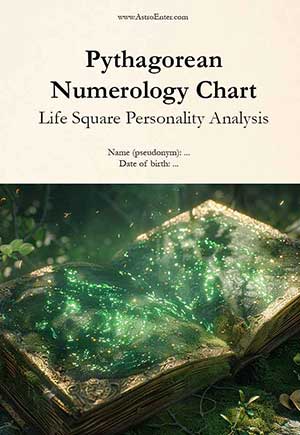
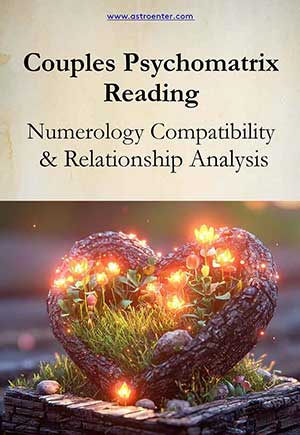
If you would like to explore your Psychomatrix on a deeper level, you can choose between two personalized readings: an individual Psychomatrix analysis or a couples compatibility reading. Each interpretation is carefully prepared by astrologer and psychologist Aga Lunari.
Couples Psychomatrix Reading –
Numerology Compatibility & Relationship Analysis
Pythagorean Numerology Chart –
Life Square Personality Analysis (Psychomatrix)